

Web Design Agency: Corporate Websites That Win Customers
A web design agency plans, designs and builds a site so that it gets found in search, loads fast on a phone, and turns visitors into enquiries rather than just looking good. At Piar Medya, corporate website projects start at $2,500 and a standard corporate site ships in 3 to 4 weeks. Three variables set the price: page count, custom software requirements, and who produces the content.
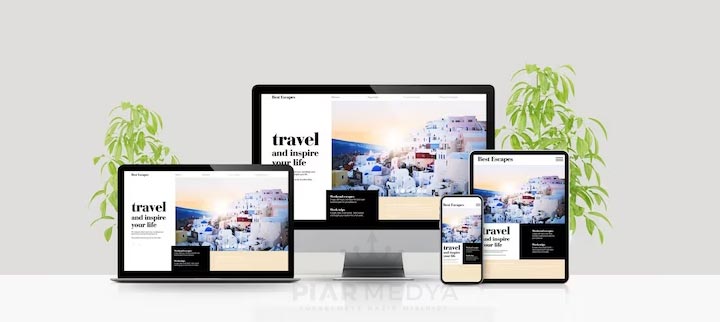
The real job of a website is not to look good; it is to win customers. A visually striking site that Google cannot find, or one that gets traffic but never makes the phone ring, is a locked shop with a polished window. Every site we build is planned around three functions at once: being found, loading fast, converting. How the three balance is covered in our guide to what web design actually is.
How Much Does a Website Cost?
Our corporate website projects start at $2,500. The reason "how much does a website cost" has no single answer is that wildly different jobs travel under the same name. A five-page brochure site and a forty-page multilingual corporate build are not the same product, which is also why "cost per page" quotes mislead: the price sits in the architecture and the software, not in the page count alone. Three variables set the quote:
- Page count and content depth: who writes the copy matters as much as how many pages there are. Content produced by your team narrows the scope; content produced by ours widens it.
- Custom software: a dealer portal, booking system, pricing calculator or third-party integration turns a design job into a software project.
- An e-commerce layer: payment infrastructure, shipping integration and product management are scoped separately; we plan that side together with our e-commerce consulting service.
Working with a team based in Türkiye changes the arithmetic in your favour: the cost base means a budget that buys a template customisation in London or New York buys genuinely custom design and development here, and Türkiye's UTC+3 clock keeps our working day overlapping with Europe, the Gulf and the US East Coast morning.
Website Builder or Custom Design?
Both have a legitimate use; the mistake is buying one when you need the other.
| Criterion | Website builder / template | Custom design |
|---|---|---|
| Upfront cost | Low | Higher; from $2,500 |
| Brand distinctiveness | Shared look with hundreds of sites on the same theme | Built from scratch around your identity |
| Speed and Core Web Vitals | Carries unused code weight | Only the code you need; a speed budget set up front |
| SEO ceiling | Hits platform limits | URL architecture, schema and internal linking fully yours |
| Right for | Validating an idea, minimal budget | Any business expected to win customers from its site |
If you do choose the builder route, choose it knowingly: the limits are visible from day one, and when growth hits them, migrating out costs more than building custom from the start.
The Process: What Happens in Which Week
A standard corporate site runs on this schedule; custom software and e-commerce projects get their own timeline in the scoping call.
| Stage | Work carried out | What you receive |
|---|---|---|
| Week 1 | Discovery call, goal and competitor analysis, sitemap, wireframes | Sitemap and page skeletons for approval |
| Week 2 | Visual design on your brand identity, homepage and template page sign-off | All page designs |
| Week 3 | Development: responsive build, speed optimisation, admin panel, SEO architecture | A browsable site on a staging address |
| Week 4 | Content entry, device and browser testing, redirects, launch, panel training | Live site plus admin panel training |
The one thing that stretches the schedule is content: when copy and imagery are not ready, the project waits. If you would rather hand content production to us, it goes into scope and is settled at the quoting stage. Delivery runs on a shared board with a named contact; approvals happen on the staging address, so you see exactly what will go live.
What "SEO-Ready" Actually Means
The phrase has been worn down to a sticker. On our side it covers six concrete items, documented in an audit report at handover:
- Crawl and index architecture: clean URLs, XML sitemap, robots rules, redirect scheme.
- A speed budget: Core Web Vitals targets (LCP, INP, CLS) are set at design time; image sizes and code weight are capped against them.
- Mobile first: Google indexes the mobile version, so the design is worked out on the narrow screen first. More in our responsive design guide.
- Structured data: organisation, breadcrumb, FAQ and service schema coded in from the start.
- Heading hierarchy and page skeleton: every page planned against a single search intent.
- Measurement: Google Analytics 4 and Search Console set up in accounts you own, with conversion events defined.
Delivered this way, the site becomes clean ground for the SEO work that follows; the first months go into growth rather than repair.
Why Is My Website Not Converting?
When a site gets traffic but no enquiries, the problem is almost never aesthetics; it is flow. A visitor has to think "I am in the right place" within three seconds, reach what they came for in two clicks, and find exactly one clear call to action at the moment they are ready to move. Why interface beauty and usage flow are separate disciplines is covered in our piece on the differences between UX and UI.
On the sites we build, conversion is part of the design rather than an afterthought: the phone number is visible on every screen, forms ask for the minimum, the quote call-to-action sits at the page's natural pauses, and every one of them is measured. How the layout changes by industry is worked through with examples in four website strategies for service sectors.
What Makes a Good Business Website? Our Launch Checklist
Every project goes through the same list before launch. You can score your current site against it too; three or more failing rows means the site is losing customers.
| Area | Minimum standard | How to verify |
|---|---|---|
| Speed | LCP under 2.5 seconds on mobile | PageSpeed Insights mobile test |
| Mobile rendering | No horizontal scroll, 48px touch targets | Browsing on a real phone |
| Reachability | Phone and quote CTA one tap away on every screen | Try it from any inner page |
| Trust signals | Real address, references, legal pages | Footer and about page check |
| Findability | Each page answering a single search intent | Search Console query report |
| Measurement | Form, call and click events counted | GA4 realtime test |
Technology: What We Use and Why
Technology choices are made for the life of the project, not for fashion. On corporate sites we build a light, PHP-based server side that any competent developer can take over later, and on the front end we write plain HTML, CSS and JavaScript that respects the speed budget instead of shipping framework weight. If you want the foundations, our HTML, JavaScript and PHP guides cover them.
The admin panel is chosen per project: a ready CMS for content-heavy sites, a custom panel where the workflow is specific to your business. Either way, being able to update the site without depending on anyone is part of the delivery; panel training happens in launch week. Domain, hosting and analytics accounts are opened in your name, so nothing about the site is rented from us.
After Launch: Maintenance, Security and Growth
Launch is not the finish line; an unmaintained stack turns into a security and speed problem over time. Optional maintenance covers backups, version updates, security monitoring and small content changes. When the site needs to grow through paid and organic channels, our Google Ads and SEO teams work under the same roof, so landing page changes take hours rather than a round of inter-agency email.
Google's own measurement tool is worth bookmarking: PageSpeed Insights.
Let's Talk About Your Project
If you already have a site, we start by assessing it: a concrete report across speed, mobile rendering, index status and conversion flow. Starting from scratch, we prepare a sitemap and scope proposal against your goals. Either way the quote is written line by line against the three variables above; there are no surprise costs later.
Request a free assessment and quote, or get in touch directly. With projects from $2,500 and a 3 to 4 week delivery schedule, we will settle the scope together.
FREQUENTLY ASKED QUESTIONS (FAQs)
Some of Our References:


SNG Certification
Used Technologies:Bootstrap + PHP 7+
Compatibility: Mobil / Tablet / Desktop

Agromer Chemical
Used Technologies:Bootstrap / JQUERY / PHP
Compatibility: Mobil / Desktop

Ekin Law Firm.
Used Technologies:HTML5 / CSS3 / JQUERY / PHP 7+
Compatibility: Mobil / Desktop

Kriptopara News
Used Technologies:HTML5 / CSS3 / JQUERY / PHP 7+
Compatibility: Mobil / Desktop


Dietitian Seyda Ertas
Used Technologies:HTML5 / CSS3 / JQUERY / PHP 7+
Compatibility: Mobil / Desktop