7 Powerful Reasons to Use Google Ads
Discover the 7 key benefits of Google Ads in 2026, from instant reach to measurable ROI. See how Piar Medya turns ad spend into profitable business growth. You will find answers to all your questions related to topic 7 Powerful Reasons to Use Google Ads in the continuation of the text.
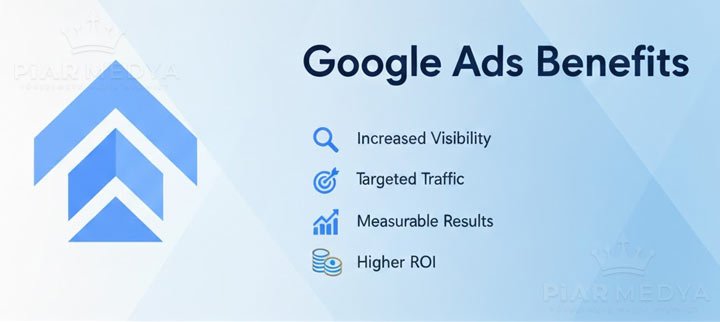
Why Should You Use Google Ads? Here Are 7 Proven Strategic Benefits
1. Instant and Laser-Focused Reach
2. Fully Measurable Results and Provable ROI
3. Unmatched Budget Control and Flexibility
4. The Opportunity to Outrank Competitors
5. A Second Chance with Remarketing
6. Increasing Brand Awareness
7. Increased Efficiency with Continuous Optimization
Strategic Investment for Business Growth
What Are the Disadvantages of Google Ads?
The main benefits of Google Ads are instant visibility, precise targeting and full budget control: your ads can appear at the top of search results within a few hours, and the cost-per-click model means you pay only when someone clicks. Targeting narrows by keyword, location, age and interests, so the budget reaches people who are already searching for what you sell. Because every impression, click and conversion is measurable, return on investment can be tracked and improved continuously.
In the competitive world of digital marketing, businesses constantly face the challenge of reaching qualified customers at the exact moment of search intent. While SEO provides sustained organic growth, scaling businesses often require immediate visibility and direct customer acquisition. In our client campaigns at Piar Medya, leveraging the world's largest search ecosystem through Google Ads serves as the fastest engine to bridge that gap.
Why Should You Use Google Ads? Here Are 7 Proven Strategic Benefits
With countless digital marketing channels available, why invest in Google Ads? What tangible advantages does the Ads platform offer to turn your marketing budget from a cost center into a profitable growth channel? The following 7 strategic benefits demonstrate why Google Ads functions as an indispensable growth engine for modern enterprises.
| Benefit | What it earns the business |
|---|---|
| Instant reach | Visibility in search results as soon as the ad is approved |
| Measurable results | Every unit of spend reported against clicks and conversions |
| Budget control | You set the daily cap and can pause at any time |
| Remarketing | A second touch with visitors who left without buying |
1. Instant and Laser-Focused Reach
Unlike traditional marketing channels or organic search optimization, Google Ads provides instant search presence. With a properly structured campaign, you can appear before high-intent buyers within a few hours. Beyond speed, targeting parameters allow granular precision: ads can target exact keyword queries, locations such as Konya, demographic segments, user interests, or past website interactions. Precise targeting ensures that your advertising message reaches qualified prospects rather than a generic crowd. If you plan to manage campaigns internally, explore our step-by-step guide to advertising on Google.
2. Fully Measurable Results and Provable ROI
Traditional print or billboard advertising makes precise attribution and revenue tracking nearly impossible. Google Ads eliminates guesswork through real-time performance measurement. Advertisers can track exact impression counts, click-through volumes, high-converting search queries, and the exact return on investment (ROI) generated by every dollar spent. Data-driven campaign management allows continuous performance improvements based on hard metrics. Advertisers can maximize efficiency further by deploying AI-powered advertising models.
3. Unmatched Budget Control and Flexibility
Google Ads scales across businesses of all sizes because budget allocation remains entirely in your control. Daily spend limits can be adjusted, paused, or scaled at any moment without penalty. Under the Cost Per Click (CPC) model, spend occurs only when an interested user interacts directly with your ad. Budget caps prevent wasted spend and preserve profit margins. Learning actionable ways to lower your CPC provides an ongoing cost advantage across competitive auctions.
4. The Opportunity to Outrank Competitors
In highly competitive verticals, Google Ads offers immediate placement ahead of established market competitors. Securing top positions above organic search listings makes your business the first option prospective buyers encounter. For new domains building organic domain authority, or established companies launching targeted seasonal campaigns, paid search provides instant market capture. Partnering with a dedicated advertising agency ensures bidding strategies remain aggressive yet cost-efficient.
5. A Second Chance with Remarketing
Most first-time visitors leave a website without completing a purchase or inquiry form. Remarketing ensures these prospective buyers are not permanently lost. Through the remarketing feature, tailored reminder ads appear across third-party websites in the Google Display Network and YouTube. Remarketing remains one of the most cost-effective methods to reinforce brand trust and convert hesitant buyers.
6. Increasing Brand Awareness
Beyond driving immediate transactional conversions, paid search consistently builds long-term brand authority. Frequent visibility at the top of search result pages creates strong category association in the minds of prospective clients. Even without direct clicks, repeated ad impressions elevate market credibility. Leveraging the Google Display Network further expands reach across niche industry publications and partner media.
7. Increased Efficiency with Continuous Optimization
Google Ads operates as an active, real-time auction rather than a static placement. Granular platform analytics reveal top-performing ad copy variations, unprofitable search terms, and high-converting landing page layouts. Systematic A/B testing and negative keyword refinement make accounts more efficient over time. Boosting your Google Ads Quality Score directly lowers effective CPCs while securing higher ad ranks.
Strategic Investment for Business Growth
When deployed strategically, Google Ads functions as an investment channel that scales revenue, qualified leads, and overall market share. Combining speed, granular targeting, flexible budgeting, and complete attribution, it remains a cornerstone of high-performance digital marketing programs.
Who you collect these benefits with also decides the outcome; the agency selection guide puts the right questions in one list.
What Are the Disadvantages of Google Ads?
A fair benefits assessment also names the limits. The most cited drawback is that visibility ends the moment spend ends: paid traffic builds no lasting equity the way organic rankings do, which is why mature accounts run ads and SEO together instead of choosing between them. Click prices also climb in crowded auctions; a single click in law, finance or insurance can cost many times what a niche retailer pays.
Management effort is the third limit. An account left on default settings spends on irrelevant queries, so negative keywords, bid adjustments and landing page tests need a regular rhythm. Some searchers also skip paid listings on purpose, which caps the share of total demand ads can capture on their own.
| Disadvantage | How to limit it |
|---|---|
| Traffic stops when spend stops | Run organic SEO in parallel so rankings keep working between campaigns |
| Rising click costs in crowded auctions | Improve Quality Score and prune wasteful queries with negative keywords |
| Needs ongoing management | Review search terms weekly or hand the account to a specialist |
To turn your advertising budget into provable, scalable revenue without managing complex platform nuances, explore Piar Medya's professional Google Ads Agency service to accelerate your growth.