What is Artificial General Intelligence (AGI)? How Machines That Think Like Humans Will Radically Change Business and Marketing
Explore what Artificial General Intelligence (AGI) is, how it differs from Narrow AI, and how it will transform digital marketing and business strategy. You will find answers to all your questions related to topic What is Artificial General Intelligence (AGI)? How Machines That Think Like Humans Will Radically Change Business and Marketing in the continuation of the text.
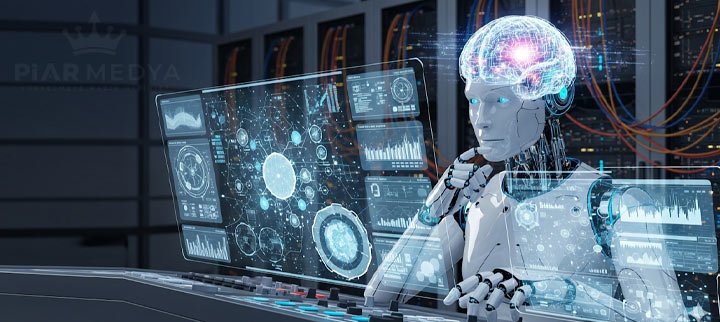
A Comprehensive Guide: Artificial General Intelligence (AGI) and Its Paradigm-Shifting Power
Narrow AI (ANI) vs. Artificial General Intelligence (AGI): What is the Core Difference?
ANI (Today's World): The Specialist with Limits
AGI (Tomorrow's World): The Intelligence That Learns and Understands
The Path to AGI: Where Are We and What Awaits Us?
The End of Marketing, or a New Beginning? AGI and Marketing
1. From Ultra-Personalization to Individual-Centric Creation
2. Full Automation from Strategy to Creation
3. "Intent Creation" and Predictive Marketing
4. The Evolution of SEO: From Keywords to Trusted Entities
Preparing for the AGI Era: Our Vision as Piar Medya
What is Answer Engine Optimization (AEO)?
Artificial General Intelligence (AGI) is a theoretical form of AI that can understand, learn, and solve any intellectual task the way a human does, rather than excelling at a single job. Every system in use today, from chatbots to ad algorithms, is still Narrow AI (ANI) built for one task. A true AGI has not yet been developed, but labs such as Google DeepMind and OpenAI are working toward it. For marketing, the shift means individual-level personalization and campaigns planned, produced, and optimized by one system.
As of 2026, artificial intelligence (AI) is now a part of every aspect of our lives. We generate text with ChatGPT, create images in seconds with Midjourney, and optimize our ads with Google Ads' smart algorithms. Yet, despite all these revolutionary developments, we are still just scratching the surface of AI's potential.
All the systems we use today are actually "Narrow AI," which is just the tip of the iceberg. The real power lying beneath the surface, the one that will change the world as we know it, has begun to appear on the horizon: Artificial General Intelligence (AGI).
A Comprehensive Guide: Artificial General Intelligence (AGI) and Its Paradigm-Shifting Power
At Piar Medya, our digital agency teams focus on understanding emerging technologies early to help businesses stay ahead of disruptive shifts. In this comprehensive guide, we explain what AGI is, how it differs from current AI models, and how this technological evolution will change the worlds of business and marketing strategy forever.
Narrow AI (ANI) vs. Artificial General Intelligence (AGI): What is the Core Difference?
Understanding the difference between these two concepts is the first step to reading the future.
ANI (Today's World): The Specialist with Limits
Artificial Narrow Intelligence (ANI) encompasses all the AI systems we use today. ANIs are specialists designed to perform a specific task with superhuman proficiency. For example:
- An AI that plays chess can beat a world champion, but it cannot make a cup of coffee unless it is programmed to do so.
- A text-writing model can write a fantastic article, but it doesn't actually "laugh" at a joke within the text.
- A Google Ads algorithm can analyze millions of data points, but it cannot grasp the strategic "why" behind your decision to launch an ad campaign.
ANIs are powerful tools, but they lack consciousness and general understanding.
AGI (Tomorrow's World): The Intelligence That Learns and Understands
Artificial General Intelligence, on the other hand, is a theoretical type of AI that possesses the ability to understand, learn, and apply its intelligence to solve any intellectual task, just like a human. The key characteristics of AGI will include:
- Reasoning and Problem-Solving: It can use logic and strategy to solve diverse and previously unencountered problems.
- General Learning: It can learn not just in a single domain, but across many different fields (music, mathematics, art, physics) simultaneously and make connections between them.
- Consciousness and Self-Awareness (Theoretical): In the most advanced AGI scenarios, it is expected to be aware of its own existence and thoughts. For more on this topic, you can read Wired's in-depth analysis of AGI.
The Path to AGI: Where Are We and What Awaits Us?
A true AGI has not yet been developed. However, research labs like Google DeepMind and OpenAI are getting closer to this goal every day. The massive data processing power that AGI will bring also raises issues of data privacy and centralization. At this point, decentralized technologies like Blockchain, which are being developed as an alternative or complement to AGI's centralized intelligence and where data is fully controlled by the user, are creating their own revolution. The digital world of the future will likely be shaped by the interaction of these two powerful technologies.
The End of Marketing, or a New Beginning? AGI and Marketing
AGI will reshape the way marketing departments and agencies operate. In reality, this will not be an end, but a more strategic and creative beginning.
1. From Ultra-Personalization to Individual-Centric Creation
What we call "personalization" today usually involves segmenting users into predefined categories. AGI, however, will be able to create a unique, real-time marketing experience for each individual user based on their current mood, past behaviors, and even predicted future needs. Every user will see a different ad copy, a different visual, and a different offer.
2. Full Automation from Strategy to Creation
A command given to an AGI in the future might look like this: "Create a launch campaign for our new vegan protein powder brand targeting a 25-35 year-old, fitness-interested audience, and aim for the highest conversion with a 10,000 TL budget." With this command, the AGI will conduct market analysis, create the strategy, generate ad copy and visuals, launch the campaign, and optimize it. In the new era, the role of agencies like Piar Medya will be to act as the "expert pilot" who guides powerful tools with the right strategic objectives. The digital marketing consulting we offer is designed precisely to prepare you for this future.
3. "Intent Creation" and Predictive Marketing
Current AI tries to predict a user's "purchase intent." AGI, however, will be able to anticipate a need or problem the user isn't even aware of yet and create the intent itself by presenting content or a product that solves it. This marks the evolution of marketing from being reactive to proactive.
4. The Evolution of SEO: From Keywords to Trusted Entities
AGI will redefine the concept of "search." We will evolve from a system that matches keywords to an "answer engine" that generates direct solutions and synthesized answers. In this new world, SEO will be much more than simple keyword optimization. The key to success will be transforming your brand into a trusted, authoritative, and expert "digital entity" that an AGI would want to reference. Google's E-E-A-T principles will never have been more important. To prepare for this process starting today, working with an SEO agency to build your brand's authority is a strategic investment in the future.
Preparing for the AGI Era: Our Vision as Piar Medya
The changes AGI will bring are both exciting and transformative. The businesses that succeed in the new era will not just be those that adopt technology, but those that understand strategic transformation and adapt their business models accordingly. At Piar Medya, we serve as a strategic partner following the latest technological advancements to transform industry insights into measurable growth for our clients. We are ready to build the future together.
What is Answer Engine Optimization (AEO)?
Answer Engine Optimization (AEO) is the practice of structuring content so that AI-driven systems such as Google AI Overviews, ChatGPT, and future AGI-level assistants can extract and cite it as a direct answer. Classic SEO competes for a ranking position on a results page; AEO competes for the answer itself. The two are not rivals: an answer engine still selects its sources from pages that are crawlable, fast, and authoritative, so AEO builds on a solid SEO foundation rather than replacing it.
In practice, AEO means answering one question per section within the first sentences, using clear headings and FAQ blocks, adding structured data, and demonstrating the expertise signals defined in Google's E-E-A-T framework. We explain how AI-generated results are already reshaping search behavior in our guide on Google AI Overviews and SEO.